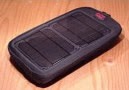
The portable power and portable solar charger world is divided into two camps: USB & 12V. USB for the small stuff, and 12V for the big stuff. The smaller solar USB chargers are designed to keep phones & iPods charged. The larger 12V solar products being used to charge just about everything up to & including laptops, medical equipment, and homes. But what if you want to use a USB source to charge a dSLR camera battery? Can you charge a 7.4V battery from a 5V source?
Digital Cameras & Solar Chargers
If you have a small point-and-shoot camera, chances are the camera uses a small 3.6V or 3.7V lithium battery pack. There are great, because they can often charge inside the camera when plugged into a USB source (ie for image download), or via small USB chargers like the LenMar Clip.
dSLR camera batteries do not have it so easy. At 7.2V or 7.4V, their battery chargers needed to provide something in the range of 8.4V, which means using a 12V system to get the voltage they need. And 12V solar kits are usually larger and more expensive than their smaller USB cousins.
Now there is a solution...
For years, I have been recommending universal chargers like the Ansmann Vario, Ansmann Vario Pro, and the Lenmar BCUNI2. These chargers do a fine job charging 3.6/3.7V, 7.2/7.4V, and AA batteries from a wall socket or 12V car socket (including 12V solar panels & battery packs). One charger to do it all. As noted in other articles I've written on the subject, the only camera battery I have come across so far that does not fit these universal chargers is the Canon LP-E6 (battery terminal contacts are too close together).
When a client needed to charge their Canon, Nikon, Olympus, Panasonic, or other dSLR camera models while out in the bush, I would direct them to 12V systems, and one of these universal chargers.
But now, a new universal charger is available that allows these larger camera batteries to be charged from a USB source. The advantage is being able to pack smaller, lighter USB solar kits & storage batteries to keep the cameras charged...
PIXO C-USB Universal Charger from PIXO of Germany
Features...
Automatically selects correct voltage & polarity
Charge rate up to 800mA
USB2 & USB3 compatible
Adjusts to a wide variety of camera battery sizes & shapes
Deep discharge battery revival mode
Brief Review...
I've had the chance to use the PIXO C-USB charger for a little over 3 months now, and so far it has performed very well. The USB input port & included cable are very robust. The charger chassis is solid, including the sliding door which holds the battery in place. The springs which help to hold the battery firmly in place are strong. The terminal blades are rather important, and the PIXO's are plenty tough - would be quite difficult to bend.
The charging performance itself has been good. It clearly indicates charging modes (charging/end), and it doesn't take much longer than a wall charger would to bring a camera battery up from 50% depletion. It is slightly slower when charging a 7V camera battery due to the voltage transform (I used a Sony NP-F550 as a test).
Conclusion...
I have no problem recommending the PIXO C-USB charger. Best of all, I am no longer bound to 12V options for dSLR users. I can now specify USB-based solar & battery packages like the Voltaic FUSE 6W or Nepal 6 Kit to people who want to take their dSLR cameras into the wild.
Please feel free to contact me with any questions regarding this charger.
Portable solar power equipment, technologies, & applications for people who work & play in the great outdoors.
Showing posts with label charging. Show all posts
Friday, October 4, 2013
Thursday, September 26, 2013
Personal Power for Nepal Trekkers
I just helped Mick Bromley of Wilderness Trekking head off to Nepal on his latest excursion with two sets of portable solar power systems. One is designed to keep a videographer's equipment charged while he chronicles Mick's legendary attention to every aspect of the Nepal experience. The second is for Mick himself, so that he is able to keep his own camera, tablet, and communications gear charged. His system will also come in handy when his clients need a power boost for their own cameras.
Here is an overview of the systems...
For the Videographer : SunLINQ 5 Solar Panel with Brunton Sustain2 Storage Battery & LP-E6 DC Charger
The SunLINQ panel folds down small & light, and features CIGS efficient thin film cells that excel in the high-UV exposure at altitude, and at the higher ambient temperatures in the lower regions of the country. The Brunton Sustain is a ruggedized lithium pack that stores 75 Watt-Hours of power... enough for 5 full charges on a Canon dSLR battery, so there is plenty of back-up in case of several days of inclement weather.
The balance is in the logistics. With the panel deployed for several hours each day during stops, or at camp, the power produced will easily offset the power being drawn for camera battery charging & video editing/archiving. The power budget was designed around the need for 2-3 Canon LP-E6 charges per day. Because it is never a good idea to drain a lithium battery below 50% on a regular basis, the videographer will be bringing several battery packs that he will top-off at various times during the day & at camp at night.
Lastly, I do not like the DC input connector provided with the Brunton Sustain2. Too fragile, and introduces a mysterious voltage drop that makes it incompatible with slightly lower voltage panels like the Powerfilm series. So, I sent one of the Modern Outpost Solar Input Cables... a tougher & much longer cable that makes camp set-up options easier.
For Mick : Voltaic Fuse 10W with Ansmann Vario Pro Charger
This is a fantastic solar kit. 10W of premium Bosch crystalline solar cells in a rugged encapsulation, set into a rugged case that can carry a laptop & tablet at the same time. The case features webbing on the back, so strapping it to the outside of a backpack is a simple task. Having all the solar charging gear in one place instead of being spread around with wiring has its advantages too. Mick simply opens the case and connects his camera charger, tablet, phone, radio, or virtually anything else he might need.
The panels produce the power he needs each day, and just in case he runs into bad weather, he has 60 Watt-Hours of power stored in the Fuse10W's internal V60 battery pack.
While laptops, tablets, and USB devices can all be connected directly to the Fuse10's internal battery pack, getting the power from the Fuse10 kit into camera batteries is done via an Ansmann Vario Pro universal charger. Plug the charger into the 12V socket on the Fuse10, snap your camera battery into the cradle, and the charger selects the correct voltage, polarity, and begins charging. It even shows you the state-of-charge so you can better manage your power usage.
Simple. Elegant. Functional. Reliable.
Mick's Client Pick : Fuse 4W with Pixo Charger
Mick and I talked about an option for his clients, should they want to bring a charger of their own. Something simple to use, simple to pack, rugged, and able to charge virtually any type of camera, phone, iPod, etc. The Voltaic Fuse 4W fits perfectly. 4 Watts of German-made Bosch panels in a small pack that straps to a backpack. Inside is room for small gadgets, & the 4000mAHr solar storage battery, capable of charging or powering everything USB including tablets.
The German Pixo charger is universal, adapting to all 3.6/3.7V camera batteries, plus all 7.2/7.4V dSLR & camcorder batteries (a neat trick not seen in other USB chargers).
This kit is able to offset approx 75% of a dSLR battery every day, or a mix of devices adding up to same.
Well, that's it. Trekking with electronics made easy.
Should you need any further details, or want help with the math concerning your own trekking power needs, please do not hesitate to contact me.
Best!
Here is an overview of the systems...
For the Videographer : SunLINQ 5 Solar Panel with Brunton Sustain2 Storage Battery & LP-E6 DC Charger
The SunLINQ panel folds down small & light, and features CIGS efficient thin film cells that excel in the high-UV exposure at altitude, and at the higher ambient temperatures in the lower regions of the country. The Brunton Sustain is a ruggedized lithium pack that stores 75 Watt-Hours of power... enough for 5 full charges on a Canon dSLR battery, so there is plenty of back-up in case of several days of inclement weather.
The balance is in the logistics. With the panel deployed for several hours each day during stops, or at camp, the power produced will easily offset the power being drawn for camera battery charging & video editing/archiving. The power budget was designed around the need for 2-3 Canon LP-E6 charges per day. Because it is never a good idea to drain a lithium battery below 50% on a regular basis, the videographer will be bringing several battery packs that he will top-off at various times during the day & at camp at night.
Lastly, I do not like the DC input connector provided with the Brunton Sustain2. Too fragile, and introduces a mysterious voltage drop that makes it incompatible with slightly lower voltage panels like the Powerfilm series. So, I sent one of the Modern Outpost Solar Input Cables... a tougher & much longer cable that makes camp set-up options easier.
For Mick : Voltaic Fuse 10W with Ansmann Vario Pro Charger
This is a fantastic solar kit. 10W of premium Bosch crystalline solar cells in a rugged encapsulation, set into a rugged case that can carry a laptop & tablet at the same time. The case features webbing on the back, so strapping it to the outside of a backpack is a simple task. Having all the solar charging gear in one place instead of being spread around with wiring has its advantages too. Mick simply opens the case and connects his camera charger, tablet, phone, radio, or virtually anything else he might need.
The panels produce the power he needs each day, and just in case he runs into bad weather, he has 60 Watt-Hours of power stored in the Fuse10W's internal V60 battery pack.
While laptops, tablets, and USB devices can all be connected directly to the Fuse10's internal battery pack, getting the power from the Fuse10 kit into camera batteries is done via an Ansmann Vario Pro universal charger. Plug the charger into the 12V socket on the Fuse10, snap your camera battery into the cradle, and the charger selects the correct voltage, polarity, and begins charging. It even shows you the state-of-charge so you can better manage your power usage.
Simple. Elegant. Functional. Reliable.
Mick's Client Pick : Fuse 4W with Pixo Charger
Mick and I talked about an option for his clients, should they want to bring a charger of their own. Something simple to use, simple to pack, rugged, and able to charge virtually any type of camera, phone, iPod, etc. The Voltaic Fuse 4W fits perfectly. 4 Watts of German-made Bosch panels in a small pack that straps to a backpack. Inside is room for small gadgets, & the 4000mAHr solar storage battery, capable of charging or powering everything USB including tablets.
The German Pixo charger is universal, adapting to all 3.6/3.7V camera batteries, plus all 7.2/7.4V dSLR & camcorder batteries (a neat trick not seen in other USB chargers).
This kit is able to offset approx 75% of a dSLR battery every day, or a mix of devices adding up to same.
Well, that's it. Trekking with electronics made easy.
Should you need any further details, or want help with the math concerning your own trekking power needs, please do not hesitate to contact me.
Best!
Tuesday, March 12, 2013
Camping With Your CPAP or BiPAP Machine
As a portable power guy, I get asked quite frequently about powering CPAP & BiPAP machines while camping. My former business partner uses a ventilator in managing his Duchenne's Muscular Dystrophy, so this application is important to me.
First Things First… What is a Watt?
It's difficult to have any discussion of electricity without some basic math. But, I will try to keep it to a minimum. All you really need to know is that I have done some calculations to know how fast your CPAP or BiPAP machine will be taking power out of a battery pack, so that I can estimate how many hours you can operate your machine while camping away from a power source before the battery needs to be recharged.
Powering the Machine…
What I have found in my research, is that a typical machine (Respironics, ResMed, and the like), will draw between 20 & 30 Watts (2-2.5Amps) when not using the humidifier. What this means is that you can use fairly standard battery packs to support your machine through several nights out in a tent.
For example, I have had clients use a battery pack with 150 Watt-Hour capacity to get a full night's sleep of 8 hours with plenty of room to spare. Others have been able to get two 6-hour nights using stingy CPAP machine settings.
Here are a few battery pack options to consider…
Brunton Impel : 145 Watt-Hours : 1-2 nights
Novuscell C150 : 150 Watt-Hours : 1-2 nights
Novuscell C220 : 220 Watt-Hours : 2-3 nights
100 AHr 12V Deep Cycle : 600 Watt-Hours : 3-4 nights
Making Connections...
Most CPAP & BiPAP machines either come with a car adaptor, or have one available as an option from the manufacturer. This is a key piece of equipment, because all battery packs are DC, and this "CLA" connector will let you plug your CPAP into the battery pack exactly as you would plug it into the dashboard of your car. All the battery packs listed above come equipped with this 'CLA' socket just like in your car, and are plug-n-play with your CPAP machine.
Can you use AC power if you want? It can be done, but it is NOT recommended for several reasons. First, inverters waste 20-30% of your battery power in making AC power which your CPAP will be turning back into DC power anyway. So don't waste this power if you don't need to... use the DC car plug for your CPAP. Secondly, most Lithium batteries do not support AC inverters. The Novuscell models listed above are able to handle small 200W inverters, but save them the stress and stick to DC. Lastly, using an inverter just adds one more piece of equipment to carry, so use only when necessary.
Portability…
One of the most important aspects of camping is to be able to go into remote areas. To do this comfortably means NOT packing anything too heavy, so it becomes a balancing act between weight and the amount of power you need each night.
The lightest battery packs are lithium-based, such as the Brunton Impel, and Novuscell models listed above. In a battery that weighs only 2-4 pounds, you can store enough power for up to 3 nights.
Recharging In The Wild…
What do you do if you need more than 1-2 nights' support for your CPAP or BiPAP machine?
In the absence of a vehicle to act as a generator for recharging your CPAP camping battery, one of the most logical solutions is to use portable solar panels. For example, a 20 Watt panel will offset approx 50% of your CPAP power usage, while a 60 Watt panel will completely replace the power you use each night.
Here are a few examples of such panels (smallest I would recommend). I have selected the panels that perform best in partial shade (ie under trees), and in low-light conditions (ie overcast), because you never know what you might get out there…
Powerfilm R-21 : Waterproof, rollable, tough
Solaris 26 : Folding efficiency
Powerfilm 20 : Folding sensitivity (the lightest option)
Affording A Portable Power System…
At this point, you might be thinking that these products are rather expensive for someone who might only be going camping with their CPAP or BiPAP machine a couple of times each summer. To help, Modern Outpost has introduced a power system rental program. Now you can save the expense of owning a portable solar power system, and be sure of getting the latest & greatest equipment for supporting your CPAP while camping.
I hope this helps.
If you have any comments, questions, suggestions, or experience that will add to this discussion, please share it with us.
Best!
Subscribe to:
Posts (Atom)