Showing posts with label canon. Show all posts

Wednesday, February 12, 2014

Solar Charger vs More Camera Batteries

The question almost always comes up... do I really need a solar charger for my upcoming wilderness trek, or should I just buy a bunch of camera batteries?
Knowing that you will be away from power for days, weeks, or even months, what is the best way to keep your camera charged?

The decision comes down to the following: how long the trip is, and how many other devices you need to keep charged (GPS, headlamps, phones, radios, etc), and how well you are able to budget power.

Remember... If you only pack camera batteries, then once you are out, you are out!

Let's look at your options for cameras first, and then we will consider your other gear...

1. Extra Camera Batteries

Most people who take their cameras on their adventures find that they get anywhere from 1-3 days per battery. Anyone sensible will be taking a spare, so with two or even three batteries, you will be able to power through 3-9 days (if nothing goes wrong!). So, for weekend trips, take a couple of batteries with you, and you will be fine.
dSLR camera are a lot more power hungry than the smaller point & shoots, and most serious photographers I talk to seem to want to budget 1 day per battery.

A quick look at the current price of dSLR batteries will quickly make you look for alternatives for longer time frames. At anywhere from $80-$120 per battery, the 2 or 3 batteries you probably already have in your camera bag will suffice if you are looking at a trip of 7 days or less. But, you will need to control your shutterbug urges and stick to a power budget!
Because when your batteries are drained... you are done with the camera.

2. Solar Storage Battery = 3 dSLR batteries

Going for longer than 1 week?
Consider the advantages of using a solar storage battery to pack the extra power you will need. Cheaper than a complete solar kit, and cheaper than buying more camera batteries.

A solar storage battery is the equivalent of 3-4 camera batteries, but when you consider that the price tag is not much more than a new Canon LP-E6 battery, the economics is obvious. Combined with your 2-3 back-up batteries, you now have the ability to go up to 2 weeks, or even 3 weeks for the smaller point-and-shoot cameras.

The advantages of using a solar storage battery...
1. Economy - saving money over buying more camera batteries.
2. Expandability - being able to add a solar panel later if you ever want to.
3. Versatility - works with any camera brand/model. There's nothing worse than having a bag full of model x batteries @ $70each, only to decide to buy a new camera a year later.


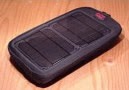
What does a solar storage battery look like?
Here's a current top seller... Voltaic V60

How would you get the power from the storage battery into your camera?
Use the solar storage battery to drive a universal battery charger or DC car charger for your particular camera model. The AC charger that came with your camera is not designed for this job.
examples: Ansmann Vario or DC LP-E6 charger.

3. Complete Solar Power Kit

This is for serious trekkers... this is the power system that generates power continuously. You will never run out of power as long as the sun comes up each day. The power varies with the strength of sunlight (latitude and weather), but we take all that into account when we recommend equipment for you.
So, if your trip is longer than 1-2 weeks, and/or you would rather not take chances with getting your power budget correct, using a complete solar kit is your best option.

solar panel -> storage battery -> battery charger -> camera battery


How does it work?
Plug the solar storage battery into the solar panel to start collecting charge.
Whenever you need to top-off a camera battery, simply fit it into the camera charger and plug the charger into the universal battery. Just like you plug it into the wall at home (except we use DC instead of AC power when we're packing it on our backs).

There are many ways to design the solar kit. From fully integrated packs, to custom plug-n-play sets of equipment. Be sure to get information about several options that fit your mode of transport, weight restrictions, and power needs.

What about other electronics?

It is a fairly simple matter to add all sorts of other devices to the mix, and have everything charged from the same power system. We budget for power consumption in things like GPS receivers, headlamp batteries, phones, and even laptops. A good solar storage battery like the V60 is able to provide the voltages needed to support all this gear, and many times you still only need one charger cradle to support them all.

Discover Your Options...

Want to know what I would recommend for you to have a completely independent power system that works everywhere?
... Just let me know where you are going, for how long, what time of year, and what camera(s) & other gear you want to pack, and I will let you know what equipment will serve you best.

Thursday, September 26, 2013

Personal Power for Nepal Trekkers

I just helped Mick Bromley of Wilderness Trekking head off to Nepal on his latest excursion with two sets of portable solar power systems. One is designed to keep a videographer's equipment charged while he chronicles Mick's legendary attention to every aspect of the Nepal experience. The second is for Mick himself, so that he is able to keep his own camera, tablet, and communications gear charged. His system will also come in handy when his clients need a power boost for their own cameras.

Here is an overview of the systems...

For the VideographerSunLINQ 5 Solar Panel with Brunton Sustain2 Storage Battery & LP-E6 DC Charger
The SunLINQ panel folds down small & light, and features CIGS efficient thin film cells that excel in the high-UV exposure at altitude, and at the higher ambient temperatures in the lower regions of the country. The Brunton Sustain is a ruggedized lithium pack that stores 75 Watt-Hours of power... enough for 5 full charges on a Canon dSLR battery, so there is plenty of back-up in case of several days of inclement weather.
The balance is in the logistics. With the panel deployed for several hours each day during stops, or at camp, the power produced will easily offset the power being drawn for camera battery charging & video editing/archiving. The power budget was designed around the need for 2-3 Canon LP-E6 charges per day. Because it is never a good idea to drain a lithium battery below 50% on a regular basis, the videographer will be bringing several battery packs that he will top-off at various times during the day & at camp at night.
Lastly, I do not like the DC input connector provided with the Brunton Sustain2. Too fragile, and introduces a mysterious voltage drop that makes it incompatible with slightly lower voltage panels like the Powerfilm series. So, I sent one of the Modern Outpost Solar Input Cables... a tougher & much longer cable that makes camp set-up options easier.

For Mick : Voltaic Fuse 10W with Ansmann Vario Pro Charger
This is a fantastic solar kit. 10W of premium Bosch crystalline solar cells in a rugged encapsulation, set into a rugged case that can carry a laptop & tablet at the same time. The case features webbing on the back, so strapping it to the outside of a backpack is a simple task. Having all the solar charging gear in one place instead of being spread around with wiring has its advantages too. Mick simply opens the case and connects his camera charger, tablet, phone, radio, or virtually anything else he might need.
The panels produce the power he needs each day, and just in case he runs into bad weather, he has 60 Watt-Hours of power stored in the Fuse10W's internal V60 battery pack.
While laptops, tablets, and USB devices can all be connected directly to the Fuse10's internal battery pack, getting the power from the Fuse10 kit into camera batteries is done via an Ansmann Vario Pro universal charger. Plug the charger into the 12V socket on the Fuse10, snap your camera battery into the cradle, and the charger selects the correct voltage, polarity, and begins charging. It even shows you the state-of-charge so you can better manage your power usage.
Simple. Elegant. Functional. Reliable.

Mick's Client Pick :  Fuse 4W with Pixo Charger
Mick and I talked about an option for his clients, should they want to bring a charger of their own. Something simple to use, simple to pack, rugged, and able to charge virtually any type of camera, phone, iPod, etc. The Voltaic Fuse 4W fits perfectly. 4 Watts of German-made Bosch panels in a small pack that straps to a backpack. Inside is room for small gadgets, & the 4000mAHr solar storage battery, capable of charging or powering everything USB including tablets.
The German Pixo charger is universal, adapting to all 3.6/3.7V camera batteries, plus all 7.2/7.4V dSLR & camcorder batteries (a neat trick not seen in other USB chargers).
This kit is able to offset approx 75% of a dSLR battery every day, or a mix of devices adding up to same.

Well, that's it. Trekking with electronics made easy.
Should you need any further details, or want help with the math concerning your own trekking power needs, please do not hesitate to contact me.

Best!

Wednesday, April 10, 2013

Solar Advice : Charging Your Camera

I thought it might be handy to provide a quick reference to the essential info you need to know in order to charge any camera. From simple point & shoot models to top-end dSLRs. I promise not to go into great detail like I do on ModernOutpost.com... just the essential info.

First things first... a couple of important FAQs...

"Can I use the charger that came with my camera?"
No. To do so requires additional equipment you won't want to carry, & you will waste a lot of solar power in the process too. For simplicity & efficiency, use a DC charger instead (see info below).

"I already have a solar panel... can I use it?"
Yes. Follow through this article as if you don't already have a panel, and then see my "What If" notes at the end.

"I have some other devices to charge, like my phone & GPS. What do I do?"
No problem. Read through this article assuming just your camera, then see the "What If" notes at the end.

Here we go...


What kind of battery does your camera use?


A : If it uses a little 3.6V or 3.7V battery pack, see the USB Charging sections below
B : If it uses a little 7.2V or 7.4V battery pack, see the 12V Charging sections below
C : If it uses AA batteries, see the NiMh AA Charging sections below

Next, we choose a DC charger to use instead of the AC model that came with your camera...

A : USB Charging
You'll be happy to know that this is the simplest, and least expensive of all the solar charging options.
Here is the charger you will want...
        Lenmar Universal USB Clip Charger
Why? It adapts to virtually any small 3.6/3.7V battery, holds it securely, uses very little power for its own functions. Simple is beautiful. Is it safe? Yes... all the smarts are in the battery packs these days anyway, so the charger doesn't need to do much.
Got a camera that can charge directly in the camera via the sync cable? Great, give it a try to make sure it works from solar... the camera might consume some power itself to do the job, but it saves you the cost of buying an additional charger.

B : 12V Charging
You have a larger battery pack for a dSLR, camcorder, or premium point-&-shoot. No problem. Here's are the chargers I most commonly recommend...
        Ansmann Vario
        Ansmann Vario Pro
        Generic 3-Way
Why one of these? They adapt to your battery, and any other camera battery you might ever own, & can power from wall socket, car, or solar panel. The 3-Way can also power from USB, but it is slow.
Want to save a few bucks? You can use one of the generic AC/DC chargers designed for your particular camera battery model. See them here.

C : NiMh AA Charging
Definitely the cheapest type of camera battery around, but you probably find that you need to charge more frequently. Use the following charger...
        PowerEx C401
Why? Your camera might use 2 AA batteries, it might use 3, it might use 4. Regardless, you will want to charge each battery individually, so you will want a charger that has single channels (ie not just 2 or 4 batteries at a time). Also, this charger doesn't use much power for itself, and it is happy with a low-power source (ie it won't complain if it can't get lots of power from your solar panel when the sun goes behind a cloud).

Next, we choose a solar panel to meet your needs...

A : USB Charging
Check the printed specs on your battery pack. Most of these small 3.6/3.7V battery packs are in the 1,000mAH range (a measure of the capacity of the battery).
If you plan to drain a full battery every 1-3 days...
        SUNLINQ1 -or- SUNLINQ Mini
If you plan to drain a full battery once or twice a day...
        SUNLINQ2
Why these? Because you are mobile, you need a panel that works well in indirect sunlight & lightweight & easy to pack. The heavy crystalline panels, and gimmicky pocket chargers are simply not your best fit.

B : 12V Charging
Check the printed specs on your battery. Most of the 7.2/7.4V batteries are in the 1200mAH range (a measure of capacity), with camcorders often upwards of 2,000mAH.
If you plan to drain a full camera battery every 2-3 days...
        Powerfilm 5 -or- Powerfilm R-7
If you plan to drain a full battery once or twice each day...
        Powerfilm 10 -or- Powerfilm R-7
If you plan to drain a full camcorder battery each day...
        Powerfilm R-14 -or- SUNLINQ4
Why these? Sensitive solar cell technology gives you power in a wide range of sunlight conditions, plus they are the lightest available for packing. The Powerfilm "R" panels are made for boats, kayaks & wet places.

C : NiMh AA Charging

I'll go on the assumption that you have good quality AA's with capacity of at least 2,000mAH.
If you plan to drain a pair of AA's every day...
        Powerfilm 5 -or- Powerfilm R-7
If you plan to drain four AA's each day...
        Powerfilm 10 -or- Powerfilm R-7
Why these? Sensitive solar cell technology gives you power in a wide range of sunlight conditions, plus they are the lightest available for packing. The Powerfilm "R" panels are made for boats, kayaks & wet places.

Putting It Together...

That's about it for solar-direct charging of your camera. Put the battery in the charger, plug the charger into the solar panel, and expose to as much sunlight as possible.

Considerations & "What If's"...

"What if I want to charge at night when it is more convenient?"
Simply use a solar storage battery to store your solar panel's power during the day. Then you can plug in your charger anytime, day or night, to charge your camera battery at full speed (ie not dependent on the sunlight conditions from moment to moment).
Which solar storage battery you choose depends on your solar panel type (USB or 12V), and how much storage you want for the locations you travel to, and of course your budget.

"I already have a solar panel... can I use it?"
Absolutely. The same recommendations outlined above apply, but you will need to compare the output of your panel against my recommendations in order to properly budget your power. For example, if you have a little 0.5W pocket USB charger, then it will take 4x as long to get the same power as the SUNLINQ1 recommended above. Consider this against your desired camera usage.
If you have a 12V solar panel, but the above discussion led you to a USB solution, then use the 3-Way charger.

"What if I have other things to charge?"
Once you have access to your own power everywhere you go, you soon find the need to charge more than what you originally intended. Plus, you will probably want to sell power to the other people in your group & recoup some of your investment!
Anyway, if you want to add something small like a phone or iPod, the above systems will handle the small additional demand. Use your USB Sync cable in the case of USB solar panels, and use your device's car adaptor if you have a 12V solar panel. Plug & play.
Smart Phones & Tablets Alert!

These things are fussy, and demand a minimum amount of power (500mA in the case of an iPhone, 1500mA in the case of an iPad). So, these will not charge solar-direct easily... use a solar storage battery to provide the necessary power.

"What if I have a lot of extra things to charge?"
We will need to talk about it to make sure you get the equipment that will cover your needs properly. Send me an email (see the sidebar or ModernOutpost.com), and we'll review your equipment list, destination, time of year, and mobility to create a system & power budget.

Thanks for reading! I hope you found it useful.
Be sure to tell your friends, colleagues, & travel mates!
Let me know if you have any questions or comments, I am always happy to help.